
24 Sep 2025
Here’s one for the Hockey Nerds!
I wanted to take the time to explain the World Ranking points system used by the FIH to order national hockey teams based on their current form. It uses a calculation to add and subtract points from each team, whenever they play an official FIH recognised ‘test match’ or tournament match.
5 minute read
The Calculation
The new model for how World Rankings are calculated was put into action from the start of 2020. The old system was ‘tournament-based’, whereas the current system is ‘match-based’. (www.fih.hockey)
Points are re-calculated after every single FIH-recognised match.
The calculation used is as follows:
P(after) = P(before) + R*W*I
P(after) = Points after the match
P(before) = Points before the match
R = Result
W = Weighting
I = Importance
Result: 10 for a win, 5 for a shootout win, 1 for a draw.
Weighting: 1 minus the difference in ranking points [winner – loser], or in the case of a draw [lower ranked – higher ranked], divided by 1000.
i.e. { 1 – ( [winner – loser] / 1000 )}
Importance: Gain/lose more points from more ‘important’ events.
10 – World Cup
10 – Olympic Games
6 – WC/OG Qualifier
6 – Continental Champs
5 – FIH Pro League
3 – Continental Qualifier
3 – Continental Champs II
2 – 3+ team invitational
2 – Continental Champs III
1 – One-off Test match
1 – Continental Champs IIII
Example: (FIH)
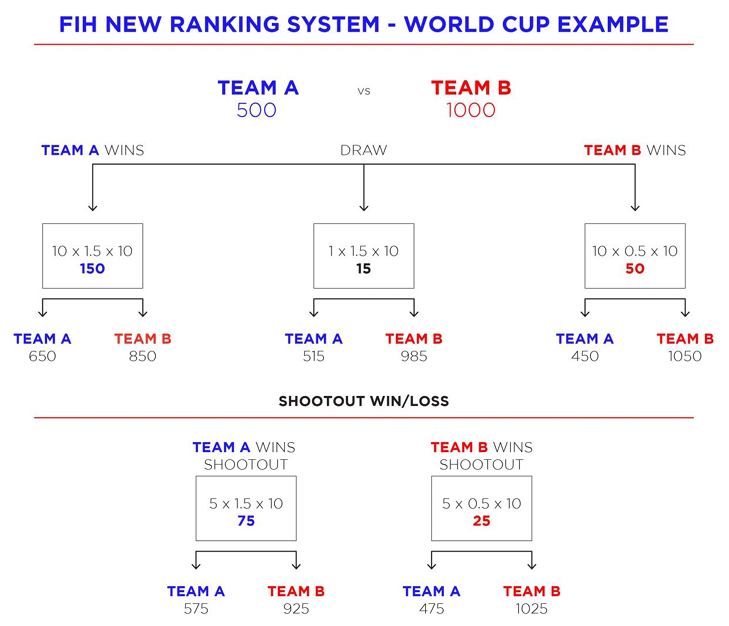
Figure from the FIH (www.fih.hockey)
As shown in the figure above, the teams will exchange the same number of points. If a lower ranked team (e.g. Team A) wins, they will take more points from the match than higher ranked team (Team B) would take if they won.
This example is that of a World Cup, which can be seen in the IMPORTANCE of 10 in the points calculation (the right-most number). The left-most number is either a 1, 5 or 10, based on the RESULT of the game. The middle number of each calculation is, of course, the weighting, calculated from initial ranking points. In the case of a Team A win, [1 – (500 – 1000)/1000] = [1 – (-0.5)] = 1.5
Real Example: (Wales)
A recent example for a game that I played in: Winning the semi final vs Austria at the EuroHockey II.
Wales P(before): 1436.66
Austria P(before): 1125.50
Result: win = 10
Importance: Continental Champs II = 3
Weighting: 1-(1436.66-1125.50)/1000 = 1-0.31116 = 0.68884
P(after) = P(before) + R*W*I = 1436.66+10*0.68884*3 = 1436.66+20.66 = 1457.32
As I write this, Wales sit in 25th place in the FIH World Rankings. Over Summer, we increased our standings to 23rd at one point, and after losing the EuroHockey final 2-1 to Italy, we ended Summer in 24th. Points have since shifted, due to the match-based system; other countries can gain points at any time in the year if they have a match scheduled.
Our long-term aim is to be hitting the top 20, which is roughly where Scotland, France & Italy sit – three countries who we have competed closely with in recent years.
What This Means
What does this world ranking system mean for international hockey?
Since it is match-based rather than tournament-based, it means that nations have more opportunities to gain (and lose) points in a year. Previously, with the tournament-based system, lower ranked nations may have only 1 (or less) opportunity to change their world ranking position.
The old system also required some level of subjectivity to decide the relative strengths of each continent – some continents were considered better, meaning that they would win more points for winning their continental championship. The new system ranks all continents with the same importance, and there is no subjectivity, only a points calculation.
Having experienced the points system first hand, as an international player, I often wonder if there would be a better method of calculating rankings. Whilst I do believe that the current system is effective, there are some key context clues that I feel may be missing.
Firstly, there is no weighting based on the size of the loss, or the context in which the loss takes place. For example, we lost 2-1 to France (much higher ranked nation) in our final pool game of Nations Cup II (2025), in a game where we needed a goal difference of -1 to go through to the semi final. Despite the result being a very close loss, and exactly what we needed to progress in the tournament, we lost the same number of points as we would have from losing 10-0, and not making a semi final. We then likely would have won both of the final 2 games, since we would have played lower teams, rather than (in reality) only winning the bronze medal match because we were playing more difficult teams. In the context of world rankings, there is a chance we would have gained more points from losing 10-0 to France in the first instance.
In my opinion, the system should consider both the size of the loss, and the context within tournaments, rewarding teams for defending their goal well, and for progressing into key matches in tournaments (e.g. semi final, making it out of the pool stages, etc.)
One very well considered nuance to the system is the ‘maximum difference in ranking points’.
France, for example, played at the Paris 2024 Olympics, and were not disadvantaged too heavily by being in a tournament filled with much higher ranked teams than themselves. This is because, if the difference in points between the 2 teams before the match is greater than 1000, a maximum rating of 2 is applied if the lower ranked team wins, and 0 if the higher ranked team wins. So when France played the Netherlands, Belgium and Germany, and lost each game significantly, they didn’t actually lose any points, and the opposition didn’t gain any points.
This is so lower ranked countries cannot be penalised for playing much higher than their rankings (since the weighting is 0), and it doesn’t discourage higher ranked countries from playing lower ranked countries for fear of losing many points (since the maximum weighting is 2).
Overall, I believe that the change to the current points system in 2020 has benefitted world hockey, leaving out subjectivity and providing more opportunities to increase your ranking points, particularly for lower ranked countries who may only have had 1 tournament per year.
Whilst I would like to see some context be added to the system, particularly in-tournament, and in terms of the size of the loss, I do appreciate the fact that there is no subjectivity within the system, and it is fair, with equal opportunities across nations and continents.
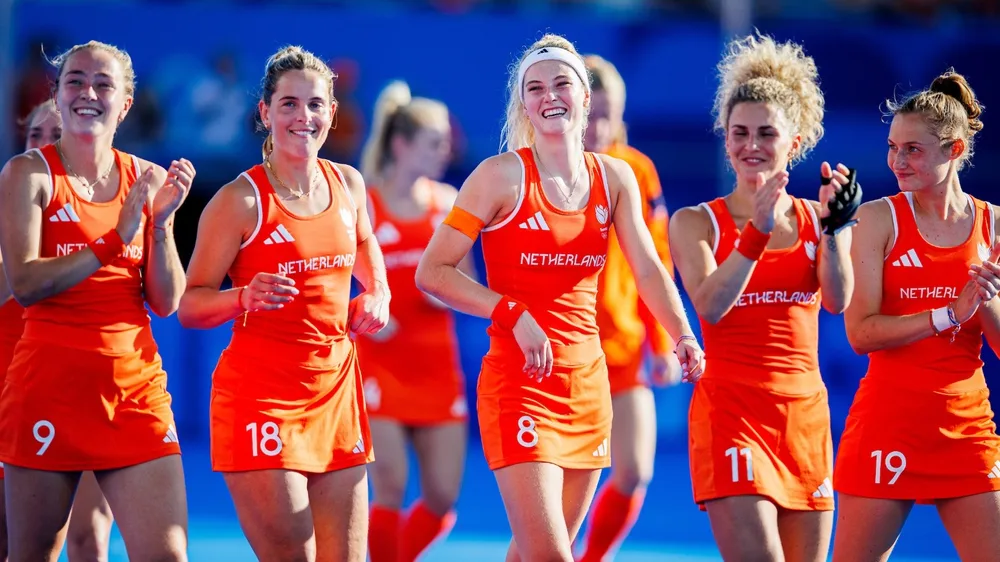
The Netherlands at the Paris Olympics, 2024 (www.fih.hockey)
Researching & writing about this topic has helped me to understand it better, and form opinions based on fact! Let me know in the comments if there are any other hockey (or other sport) topics you would like to see explained…
-Amy
Leave a Reply